
Board-up and opening protection in Wichita, KS
Opening protection is the part of Fire Damage Restoration in Wichita, KS concerned with gaps left in windows, doors, walls or the roof. Temporary coverings address exposure while the rest of the house is examined. They should be described separately from the completed repair so a boarded opening is not mistaken for completed reconstruction.
Begin with what is open
A house can have a damaged window beside an otherwise intact wall, a forced door that no longer closes or a roof section opened during suppression. Those conditions differ from smoke film on a ceiling. On the phone, describe only the openings you already know about. There is no need to climb, move debris or enter a restricted area to make the description more complete.
The exterior examination can record the type and location of each opening, access to it and the condition around it. That record informs the temporary protection proposal. It also marks where the eventual window, door, wall or roof repair needs a separate decision. The covering and the surrounding construction should not disappear into the same broad line.
Access restrictions remain with the authority responsible for the property. A restoration call does not change those restrictions. If an opening cannot yet be examined, the written proposal should say what remains unknown rather than imply that the whole exterior has already been assessed. An honest boundary is more useful than a complete-looking list without examination behind it.
Temporary coverings have a limited job
Plywood can be fitted over an affected opening and temporary coverings considered for an exposed roof area. The proposed professional work needs to account for the surrounding material and access. This feature is not an installation guide. It explains the distinction between limiting exposure in the interim and repairing the building assembly afterward.
A board covering a window does not repair the window frame or the adjacent wall. A roof covering does not establish the condition of the rafters or decking beneath it. Those differences should remain visible in the quote so a homeowner can understand what is being proposed now and what still belongs in the later repair scope.
Some openings also form the route used for authorized access during restoration. The plan needs to consider that route rather than assume every door can simply be closed in the same way. Details of access and any restrictions should be discussed for the property itself. The public guide does not decide who may enter or when.
Wichita wind changes the exposure question
Wichita is breezy through much of the year, with spring the windiest part of the seasonal pattern described in the inherited local facts. An open house can take in wind-driven rain, dust and leaves. That is a reason to include exposure in the conversation, not a reason to promise a particular arrival time or a result from a particular covering.
The opening's position and the condition of the surrounding building affect the proposed work. A low window and an upper roof opening do not present the same access question. A damaged wall edge may need further evaluation before a temporary attachment is specified. The scope should describe those conditions rather than reduce the job to the size of a plywood sheet.
Temporary protection may need further attention as conditions change. The proposal should explain whether later examination of coverings is included and how subsequent repair work relates to them. It should not imply an indefinite maintenance arrangement unless that arrangement is actually described. The eventual replacement work remains a separate part of the job.
Water is connected, not identical
A house with openings may also contain water used during suppression. Closing an opening does not establish how wet the wall or floor layers are. Moisture examination, extraction where appropriate and drying belong on their own lines. Keeping them separate makes clear why a covered exterior does not mean the interior is ready for finishes.
Wet materials can extend beyond the place where standing water was visible. Carpet pad, wall bottoms and insulation may need consideration as part of the wider plan. The walk-through can identify where the moisture question needs further work. The board-up description should not imply that every affected layer has been examined or dried merely because the covering task is complete.
Contents near an exposed opening may also need movement or separate handling. If that work is proposed, it should be listed rather than assumed. A window covering, a moisture task and contents handling can happen within the same room while still requiring different descriptions. The whole-house feature explains how a connected scope can preserve those boundaries.
What the exterior photograph can explain
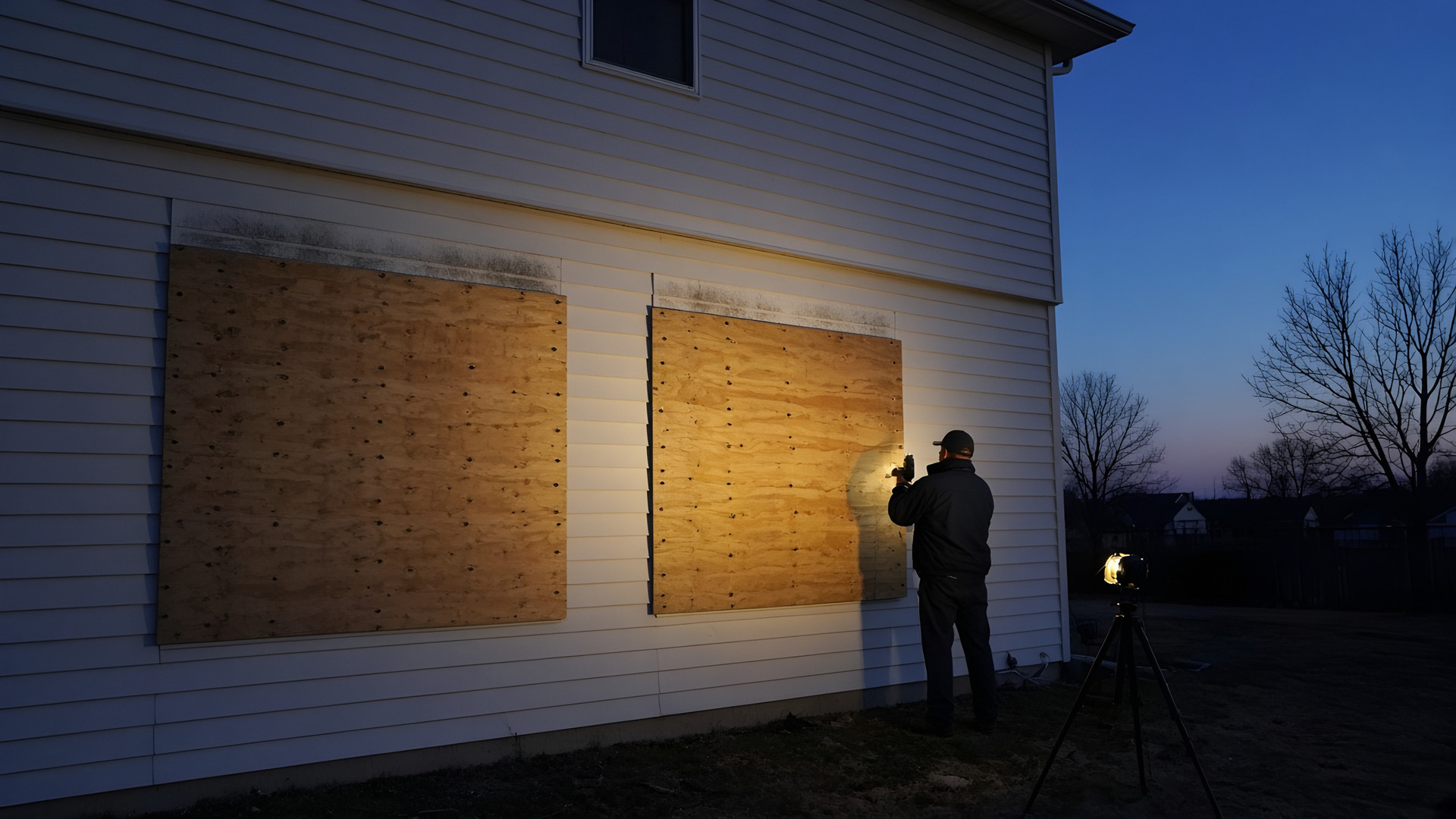
The supplied dusk photograph shows a vinyl-sided house with covered openings and a work light. It illustrates temporary closure, not a construction detail to copy. The number or arrangement of visible attachments is not a specification. The image should never be used to tell whether another house has appropriate coverings or whether its structure can remain.
Likewise, the plywood in the Home photograph identifies a stage after damage rather than a completed repair. Keeping those images at a respectful distance lets the page explain the work without dramatizing the event. Neither photograph is a customer account, and neither establishes the condition of a property that has not been examined.
The useful questions are practical: which openings are included, what remains inaccessible, what temporary work is proposed and what later assembly needs repair? A written description can answer those questions in ordinary language. It does not need an illustrated construction recipe or a promise about how long a temporary covering will last.
Separate the quote into understandable parts
Cost depends on the openings, their access, the surrounding condition and any related tasks included in the proposal. An upper opening may require a different approach from a ground-level window. Roof exposure can involve questions that are not present at a door. This page offers no numerical range because the particular house has not been examined.
A written quote should distinguish temporary boards or roof coverings from water work, debris handling and replacement components. If some parts need further examination, their status should be stated. The homeowner can then see which proposal addresses exposure and which later proposal concerns the reconstruction itself.
The scope can also explain what happens to temporary coverings when replacement work begins. That connection matters because a window order or a framing repair may change access to the opening. It should not be left as an assumption buried between unrelated headings. Temporary and replacement work can be coordinated without pretending they are the same service.
The next page is the repair page
If the opening is connected to damaged framing, the framing and finishes feature is the appropriate next discussion. Structural evaluation comes before concealment. A covering cannot establish whether a wall, joist or roof member should be retained, and a photograph cannot settle that question either.
For structural and remodeling requirements in Wichita or unincorporated Sedgwick County, confirm with the Metropolitan Area Building and Construction Department. Andover, Derby and Newton have their own city permit questions. Temporary protection should not be used to infer an exemption or a requirement for a particular later repair. The office responsible for the property is the place to confirm it.
Call Wichita Fire Damage Restoration Pros with the town and the openings already known to be exposed. Mention water or adjoining damage if it is already part of your information. The purpose of the call is to discuss availability and the next examination, not to ask you to inspect the roof or specify a covering yourself.
Keep the exposure record separate from the repair record
An exterior description can be useful even when the interior examination remains incomplete. It can identify known openings, the proposed temporary work and any limitations on access. That record should not be expanded into claims about hidden framing or moisture simply to make the proposal appear more finished.
The later repair record can refer to the same opening while addressing different materials. A window unit, its surrounding wall and the finishes inside may need different tasks. Keeping those tasks connected by location makes the sequence legible without treating the temporary board as evidence that the whole assembly has been resolved.
Ask what remains to be decided after the covering work. That question can reveal whether replacement components, adjoining repairs or further examination are included or excluded. The answer should be written for the particular property, not copied from a standard promise about what every opening protection job contains. The house and the proposed work are the basis of the quote.
